

A transfer moves IRA assets trustee-to-trustee, with no tax reporting and no deadline risk. A rollover moves a distribution, either directly or through your hands, between different account types. For IRA-to-IRA moves, use a transfer. For employer plan-to-IRA moves, use a direct rollover. Avoid indirect rollovers whenever you have a choice.
The biggest dangers you need to know upfront:
- The 60-day rule turns a late deposit into a taxable event, plus a possible 10% penalty.
- Employer plans withhold 20% automatically on indirect rollovers, and you have to replace that money out of pocket.
- You only get one IRA-to-IRA indirect rollover every 12 months.
Key Takeaways
Choosing a trustee-to-trustee transfer over an indirect rollover eliminates the 60-day deadline, mandatory withholding, and the one-per-12-month limit in a single decision.
| Point | Details |
|---|---|
| Default to transfers | Use trustee-to-trustee transfers for IRA-to-IRA moves since they're nonreportable and carry no deadline. |
| Request direct rollovers | Ask plan administrators by name for a direct rollover when leaving an employer plan to avoid 20% withholding. |
| Track the 60-day clock | If you accept an indirect rollover, the deadline starts the day after you receive the funds, not when you cash the check. |
| Watch the 12-month limit | You get one IRA-to-IRA indirect rollover every 12 months; a second one becomes fully taxable. |
| Handle RMDs first | Required minimum distributions must be paid out before the remaining balance can transfer or roll over. |
Table of Contents
- IRA Transfer vs Rollover: How Trustee-to-Trustee Moves Work
- What Is a Rollover, and How Do Direct and Indirect Rollovers Differ?
- Tax Forms, Withholding, and the 60-Day Rule Explained
- Should You Choose a Transfer or a Rollover?
- How to Execute Each Method Step by Step
- Mistakes That Turn a Simple Move Into a Tax Bill
- How Goldiraguide Helps You Apply These Rules to a Precious-Metals IRA
- Why the Safe Option Is Almost Always the Boring One
- Sources
IRA Transfer vs Rollover: How Trustee-to-Trustee Moves Work
An IRA transfer happens when you tell your current custodian to send your funds directly to your new custodian. You never touch the money. No check gets mailed to your house, and no distribution hits your bank account. The two institutions handle the paperwork between themselves. That is why transfers are often called trustee-to-trustee movements.

Because you never take possession of the funds, the IRS treats transfers as nonreportable. There's no 1099-R, no tax withholding, and no 60-day clock ticking in the background. That single feature is why financial professionals tend to recommend transfers as the default choice for moving money from one traditional IRA to another, or from one Roth IRA to another.
A few limits matter here:
- You can transfer traditional-to-traditional or Roth-to-Roth, but moving between account types (say, traditional to Roth) is a conversion, not a transfer, and it does carry tax consequences.
- SIMPLE IRAs have a two-year holding requirement before assets can move penalty-free to another IRA type.
- A transfer can't be used to satisfy a Required Minimum Distribution. If you're required to take an RMD in the year you're moving funds, that amount has to be paid out to you first, and only the remainder can be transferred.
Pro Tip: Custodians can charge outgoing transfer fees even though the move itself is tax-free. Call ahead and ask for a written fee schedule before you initiate anything.
What Is a Rollover, and How Do Direct and Indirect Rollovers Differ?
A rollover moves retirement funds between different types of accounts, most often from an employer-sponsored plan like a 401(k) into an IRA. Unlike a transfer, a rollover is a legitimate distribution first. What happens to that distribution next determines whether you're in safe territory or dangerous territory.
Direct rollover. Your plan administrator sends the funds straight to your new IRA custodian, made payable to the custodian, not to you. Because the money never lands in your hands, there's no mandatory withholding, and the 60-day clock never starts. This is functionally as safe as a transfer.
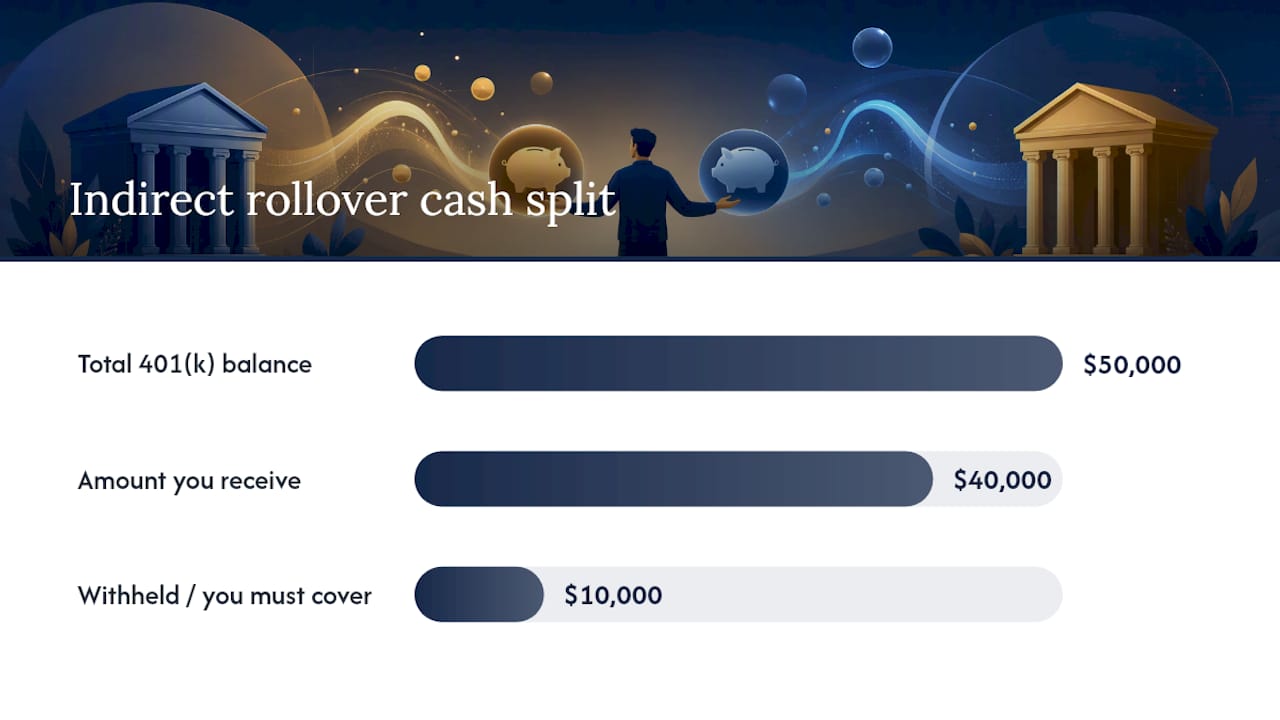
Indirect rollover. The plan cuts a check to you, and you're responsible for depositing the full amount into an IRA within 60 days. If your 401(k) balance is $50,000, you receive $40,000, but you still owe the IRA the full $50,000 within 60 days if you want to avoid taxes on the difference. That means coming up with the missing $10,000 from your own savings.
Common situations that trigger a rollover:
- Leaving a job and moving your 401(k) into an IRA.
- Consolidating a small, orphaned plan balance from a former employer.
- Converting pretax funds to a Roth IRA (a specific type of rollover with its own tax bill).
One rule trips up more savers than any other: the one-per-12-month limit applies to IRA-to-IRA indirect rollovers. Do it twice in a rolling 12-month window, and the second one becomes fully taxable. That limit doesn't touch trustee-to-trustee transfers or rollovers coming from an employer plan, which is one more reason those routes are usually the smarter play.
Tax Forms, Withholding, and the 60-Day Rule Explained
The paper trail is where transfers and rollovers really part ways. Since a transfer never becomes a distribution, your custodian doesn't generate a 1099-R for it, and you won't see it reported to the IRS as taxable income. A rollover is a different story: the distributing institution issues Form 1099-R reporting the distribution, and the receiving IRA custodian issues Form 5498 reporting the rollover contribution. You'll want both forms when you file, even though a properly executed rollover shouldn't generate a tax bill.
The 60-day countdown starts the day after you receive the distribution, whether that's a direct deposit or a paper check in your mailbox.
The IRS does grant waivers of the 60-day rule, but only in narrow circumstances like a documented bank error or a natural disaster. Self-certification exists as an option, but it is not a rubber stamp, and leaning on it as your plan B is a genuine gamble.
Withholding rules add another layer:
- Employer-plan distributions paid to you are subject to mandatory 20% federal withholding.
- IRA-to-IRA indirect rollovers carry optional 10% withholding, which you can decline.
- Either way, you must deposit the gross pre-withholding amount to avoid tax on the shortfall, which means covering the withheld portion from outside funds.
Keep every notice, check stub, and deposit confirmation for at least three tax years. If the IRS ever questions the move, that paperwork is your defense.
Should You Choose a Transfer or a Rollover?
The decision usually isn't close once you know which category your move falls into.
- Moving IRA to IRA? Use a trustee-to-trustee transfer every time you can. It sidesteps the 60-day deadline, the withholding headache, and the one-per-year limit entirely.
- Leaving an employer plan for an IRA? Ask your plan administrator specifically for a direct rollover. Say those words. Some HR departments default to cutting a check unless you request the direct option by name.
- Only offered a check? That's an indirect rollover. Before you accept it, line up outside funds to cover the 20% that will be withheld, and mark your calendar for day 60, not day 59.
Special cases deserve their own note. Roth conversions are technically rollovers and trigger income tax on the converted amount, even when done correctly. SIMPLE IRAs can't move penalty-free until you've held the account for two years. And if you're in an RMD year, remember your required distribution has to come out first. Our Gold IRA RMD calculator can help you figure out that number before you initiate anything.
Pro Tip: If you're rolling a traditional 401(k) into a Roth account, ask your plan administrator whether they can split the distribution, sending pretax dollars as a direct rollover and handling the Roth portion separately. It keeps the tax math cleaner.
How to Execute Each Method Step by Step
For a trustee-to-trustee transfer:
- Open the receiving account first and get the account number ready.
- Contact the new custodian and ask them to initiate the transfer on your behalf. Most institutions prefer to manage this themselves rather than have you coordinate both sides.
- Confirm with both custodians once assets have moved, and check your next statement to verify the balance landed correctly.
- Request a written fee schedule beforehand so there are no surprise charges on either end.
For a direct rollover:
- Contact your plan administrator and request a direct rollover specifically, made payable to your new IRA custodian.
- Confirm the receiving custodian will accept the incoming funds and has an account ready.
- Verify with the plan administrator that no withholding was applied, since a properly executed direct rollover shouldn't trigger any.
For an indirect rollover, when it's your only option:
- Expect 20% withholding if the money is coming from an employer plan.
- Deposit the full gross amount, replacing the withheld portion from savings, within 60 days.
- Keep copies of the distribution notice, the check, and your deposit confirmation.
Once the dust settles: confirm you received both Form 1099-R and Form 5498, update your beneficiary designations on the new account, and check that your investment allocation matches your intentions. Readers moving employer-plan funds into precious metals often start with our Gold IRA rollover guide for the sequencing specific to that move.
Mistakes That Turn a Simple Move Into a Tax Bill
Most of the costly errors here are entirely avoidable, which makes them frustrating when they happen.
- Missing the 60-day window. Treating IRS waivers as a safety net instead of an emergency exception is the single most common misstep.
- Not replacing withheld funds. If your 401(k) withheld 20% and you only deposit what actually hit your bank account, the IRS treats that shortfall as a taxable distribution.
- Doing two indirect IRA-to-IRA rollovers within 12 months. The one-per-year limit makes the second one fully taxable, no exceptions for good intentions.
- Ignoring RMDs during the move. If you're required to take a distribution that year, it has to come out before any transfer or rollover happens.
How Goldiraguide Helps You Apply These Rules to a Precious-Metals IRA
Moving retirement funds into gold or silver follows the same transfer and rollover rules covered above, just applied to a different asset class. Goldiraguide built resources around each common path:
- Traditional IRA to Gold IRA transfer guide for readers consolidating IRA assets into precious metals.
- 401(k) to Gold IRA rollover guide for direct rollovers from an employer plan.
- Roth IRA to Gold IRA rollover guide for the tax specifics of Roth conversions.
- Precious Metals IRA setup guide for what happens once your funds land in the new account.
Each guide maps to the checklists above, so you're never guessing which method applies to your situation.
Why the Safe Option Is Almost Always the Boring One
Most of the confusion around this topic comes from treating rollovers as the default and transfers as some kind of workaround. It's backward. If you're moving IRA money, the transfer is the boring, unglamorous choice, and boring is exactly what you want when the alternative is a five-figure tax bill triggered by a missed FedEx delivery.
The conventional advice tends to focus on the mechanics of the 60-day rule without emphasizing how avoidable it is in the first place. Almost nobody needs an indirect rollover. Plan administrators can nearly always send funds directly if you ask by name. The failure point isn't the rule, it's not asking the right question at the start of the process.
If you're considering moving retirement funds into precious metals, start with the transfer or direct rollover conversation before you look at any provider. Get the account movement right first. Everything else, including which custodian you choose, matters far less than avoiding a preventable tax event.
— Jeff
This article is general information, not a substitute for advice from a qualified financial advisor. Consult a qualified financial professional about your own circumstances before acting on anything here.
Sources
- Rollovers of retirement plan and IRA distributions | Internal Revenue Service
- What is the 60-day rollover rule? | Fidelity
- IRA rollovers and transfers - Bogleheads
Recommended
- Gold IRA Rollover Guide (Step-by-Step, 2026) | GoldIRA Guide
- Rolling Over Your 401(k) to a Gold IRA: Tax-Free Guide | GoldIRA Guide
- Gold IRA Rollover Calculator: See Your Projected Retirement Value (2026) | GoldIRA Guide
- Silver IRA Rollover Guide (2026): Steps, Rules & Mistakes to Avoid | GoldIRA Guide