

Your 2026 IRA contribution deadline is April 15, 2027, the federal tax-filing deadline, unless the IRS issues a disaster-area postponement. For 2026, you can contribute $7,500 if you're under 50, or $8,600 if you're 50 or older, thanks to the catch-up provision. That cap applies only to fresh-cash deposits.
- Deadline: April 15, 2027, for tax year 2026
- Under 50: $7,500 annual limit
- 50 and older: $8,600 annual limit (includes catch-up)
- Rollovers and transfers: not subject to this cap
Pro Tip: If you're rolling over a 401(k) or another retirement account into a Gold IRA, none of that money counts against your $7,500 or $8,600 limit. That cap only governs new money you deposit directly.
Key Takeaways
Making a compliant 2026 Gold IRA contribution requires knowing the April 15, 2027 deadline, the $7,500/$8,600 caps, and the rollover exception, then confirming your tax-year designation in writing.
| Point | Details |
|---|---|
| Deadline is fixed | April 15, 2027, is the cutoff for 2026 IRA contributions, extensions don't move it. |
| Know your cap | $7,500 under 50, $8,600 at 50 or older, applies to fresh cash only. |
| Rollovers are uncapped | Transfers from a 401(k) or other IRA don't count against your annual limit. |
| Get it in writing | Ask your custodian to confirm the transaction date and tax-year designation. |
| No do-overs on missed deadlines | Unused contribution room for 2026 doesn't carry forward into 2027. |
Table of Contents
- What Are the 2026 IRA Contribution Limits?
- When Is the Deadline to Contribute for 2026?
- How Do Gold IRA Contributions Actually Work?
- Who Can Contribute, and Do Income Limits Apply?
- What Happens If You Contribute Too Much or Miss the Deadline?
- How Do You Contribute to a Gold IRA Before the 2026 Deadline?
- Where Can You Learn More About Gold IRA Rules?
- Where to Verify These Rules Yourself
- What Actually Matters About the 2026 Deadline
- Frequently Asked Questions
- Sources
What Are the 2026 IRA Contribution Limits?
The IRS confirmed the 2026 IRA contribution limit at $7,500 for savers under 50, with an $8,600 cap for those 50 and older. That $1,100 catch-up amount exists because Congress assumes people closer to retirement need to accelerate savings, and the IRS adjusts it periodically for inflation.
These limits apply the same way whether you hold a Traditional IRA, a Roth IRA, or a Gold IRA structured as either. The dollar ceiling is identical across account types. What differs is deductibility and eligibility, which depends on your income, not your account's name.
- $7,500 limit if you're under 50
- $8,600 limit if you're 50 or older
- Same caps apply to Roth and Traditional IRAs
- Rollovers and trustee-to-trustee transfers don't touch this limit at all
That last point matters more than most people realize. IRS Publication 590-A draws a clear line between a "contribution" (new money you're adding) and a "rollover" (money moving from one qualified account to another). Only the former counts against your annual cap. If you're self-employed or run a small business, SEP and SIMPLE IRAs carry much higher limits. Check the IRS retirement topics page for those figures, since they don't follow the standard IRA schedule.
When Is the Deadline to Contribute for 2026?
Your contribution window for tax year 2026 runs from January 1, 2026, through the tax-filing deadline in early 2027. Vanguard confirms this window closes on the regular filing deadline, not on any extended filing date.
Here's how to make sure your money actually lands in the right tax year:
- Tell your custodian explicitly which tax year the deposit is for. Most custodians default to the current calendar year unless you specify otherwise.
- Get written confirmation of the tax-year designation before you consider the job done.
- File early in the year if possible. Waiting until March or April increases the odds of a processing delay pushing your deposit past the cutoff.
Filing Form 4868 to extend your tax return does not extend your IRA contribution deadline. Your 2026 contribution is still due by April 15, 2027, extension or not. The IRS can shift this date for federally declared disaster areas, and when it does, the change gets posted on IRS.gov, not buried in a press release you'd have to hunt for.
Pro Tip: Don't wait for tax season to make this decision. Vanguard's own guidance points out that contributing earlier in the year gives your money more time in the market and cuts your risk of a processing snag near the deadline.
How Do Gold IRA Contributions Actually Work?
A fresh-cash contribution to a Gold IRA works exactly like a Traditional or Roth IRA deposit: you send new money, subject to the $7,500 or $8,600 cap. A rollover is different. You're moving existing retirement funds, often a 401(k) or another IRA, into a Gold IRA custodian account, and that transfer isn't capped by the annual limit at all. This is how most Gold IRA investors build meaningful positions, since $8,600 a year buys a modest amount of metal, but a $200,000 rollover doesn't.
The mechanics involve more steps than a typical brokerage transfer. Your custodian receives the funds, you select an approved dealer, the dealer purchases the metal, and it ships to an IRS-approved depository. Typical rollovers settle in one to three weeks, assuming no complications.
- Dealer shipment delays can push settlement past your intended window
- Custodians sometimes post transactions slower than promised
- A missing tax-year designation can misfile your contribution entirely
Ask your custodian for written confirmation of both the transaction date and the tax-year designation. That single document is your proof if anything gets questioned later, and it costs you nothing to request.
Who Can Contribute, and Do Income Limits Apply?
You need compensation or earned income to contribute to an IRA. If you're not working but your spouse is, a spousal IRA can still let you contribute using your spouse's income.
The $7,500 and $8,600 caps apply evenly across Roth and Traditional accounts, but income determines what you can actually do with them. Modified adjusted gross income (MAGI) phase-outs control whether you can deduct a Traditional contribution or contribute to a Roth at all.
- Contribution requires earned income, yours or your spouse's
- Dollar caps are identical for Roth and Traditional
- MAGI phase-outs determine Roth eligibility and Traditional deductibility, not the contribution cap itself
- Active participation in an employer plan lowers or eliminates your Traditional deduction at higher income levels
The IRS publishes the exact 2026 MAGI brackets for both filing statuses. Check your number against those tables before you assume a Roth contribution is even allowed. Getting this wrong doesn't just cost you a deduction, it can trigger an excess contribution you have to unwind.
What Happens If You Contribute Too Much or Miss the Deadline?
Exceeding your limit triggers a 6% excise tax on the excess amount, charged every year it stays in the account uncorrected. Fidelity outlines the fix: withdraw the excess plus any earnings on it before your tax filing deadline, and the penalty disappears.
- Excess contribution: withdraw the overage and its earnings before the filing deadline to sidestep the 6% tax entirely.
- Wrong tax-year posting: contact your custodian immediately, most can reclassify a deposit if you catch it early.
- Missed deadline: that year's contribution room is gone for good. IRAs don't allow carry-forward of unused space into the next year.
Disaster-area postponements are the one exception to a hard cutoff, and the IRS announces those directly on IRS.gov as they happen.
How Do You Contribute to a Gold IRA Before the 2026 Deadline?
- Decide your funding type. Fresh cash hits your annual cap; a rollover or transfer doesn't.
- Confirm your limit. $7,500 under 50, $8,600 if you're 50 or older.
- Contact your custodian early, especially if you're rolling over an existing account.
- Designate the tax year in writing when you initiate the transaction.
- Choose your funding method. ACH and wire transfers post faster than mailed checks, which matters if you're contributing close to the deadline.
- Coordinate dealer and custodian timing. Metals purchases and depository delivery typically need one to three weeks, so start well before April.
- Get confirmation and keep it. A dated statement showing the tax-year designation protects you if a question comes up later.
Pro Tip: If you're contributing in the final week before April 15, 2027, use ACH or wire transfer rather than a check. Mailed checks depend on postal timing and custodian processing speed, both of which can eat into days you don't have.
If you discover an error after the fact, an excess contribution can often still be withdrawn penalty-free before the deadline, and a rollover misclassified as a contribution can sometimes be corrected with your custodian's help. Don't assume it's unfixable; call first.
Where Can You Learn More About Gold IRA Rules?
Goldiraguide breaks down the numbers behind your 2026 cap in more detail on our Gold IRA contribution limits guide, and our Gold IRA rules page covers the compliance mistakes that trigger penalties.
- Personalized matching based on your investment goals, not a one-size-fits-all recommendation
- Transparent fee comparisons across custodians, with no hidden markup disclosed after the fact
- Independent, expert-reviewed rankings of top-rated precious metals dealers
- BBB-backed reputation signals you can verify independently
The IRS remains the final word on limits and deadlines. Nothing here replaces a conversation with a qualified tax advisor who knows your specific situation.
If you're still deciding whether a Gold IRA fits your retirement plan at all, our honest breakdown of the pros and cons is a reasonable place to start before you commit any money.
Where to Verify These Rules Yourself
- IRS Publication 590-A for contribution rules
- IRS newsroom announcement on 2026 limits
- Vanguard's deadline explainer
- Goldiraguide's Gold IRA withdrawal rules for related account mechanics
What Actually Matters About the 2026 Deadline
Most coverage of IRA deadlines treats every account the same way, cash in, deadline hit, done. That framing breaks down the moment you're dealing with a Gold IRA, because the real bottleneck isn't the IRS calendar. It's the custodian and dealer chain that has to purchase metal and get it into a depository before your paperwork counts as complete.
The conventional advice, "just contribute before April 15," undersells how much lead time a rollover or metals purchase actually needs. A wire transfer clears in a day. A rollover with dealer settlement can take three weeks even when nothing goes wrong. If you're relying on the calendar deadline as your planning horizon, you're already cutting it too close.
What should change is when you start, not just what you contribute. Treat March 1 as your real deadline for anything involving a rollover, and treat April 15 as the backstop for fresh-cash deposits only. That's the distinction the typical explainer skips, and it's the one that actually protects your contribution room.

Frequently Asked Questions
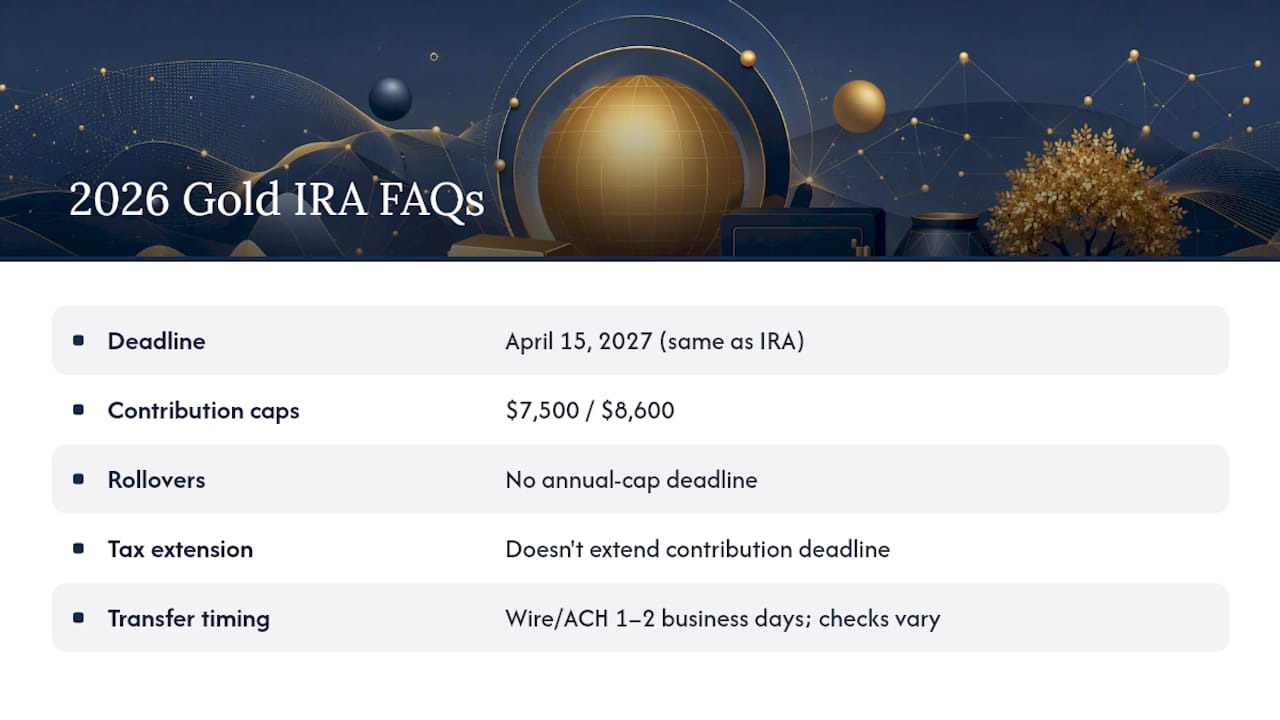
Does the 2026 Gold IRA contribution deadline differ from a regular IRA? No. Both follow the same April 15, 2027 deadline and the same $7,500/$8,600 caps for fresh-cash deposits. Rollovers into a Gold IRA have no deadline tied to the annual cap at all.
Can I still contribute for 2026 if I filed a tax extension? Filing Form 4868 extends your tax return, not your contribution deadline. You still must contribute by April 15, 2027, regardless of extension status.
Do check, ACH, or wire transfers have different cutoff considerations? Yes. Wire and ACH transfers typically post within one to two business days, while mailed checks depend on delivery time plus custodian processing. If you're contributing in the final days before the deadline, wire or ACH is the safer choice.
What if my Gold IRA rollover doesn't settle before April 15, 2027? Rollovers aren't bound by that deadline since they're not annual contributions. Only fresh-cash deposits face the cutoff, so a slow-settling rollover doesn't cost you contribution room.
This article is general information, not a substitute for advice from a qualified financial advisor. Consult a qualified financial professional about your own circumstances before acting on anything here.
Sources
- IRS newsroom: 401(k) limit increases to $24,500 for 2026; IRA limit increases to $7,500
- IRS Publication 590-A
- Vanguard: IRA contribution deadlines
- IRA contribution limits for 2026 | Fidelity
- How Much Can You Put Into a Gold IRA Each Year? (TaxSharkInc)
Recommended
- Gold IRA Contribution Limits 2026: How Much Can You Put In? | GoldIRA Guide
- Gold IRA Rules (2026): Break These And You Could Trigger Taxes And Penalties | GoldIRA Guide
- Can I Add to My Gold IRA After Retirement? Contribution Rules at 65, 70, and Beyond | GoldIRA Guide
- Gold IRA Withdrawal Rules: Age, Penalties, RMDs, and In-Kind Distributions (2026) | GoldIRA Guide